
Every general contractor in North Carolina has a slide with a lab on it.
That is not what a pharma owner is asking. The question is whether your people have built space that has to test at ISO 5, and kept it clean enough to pass.
This is for general contractors, and for the MEP and specialty firms whose work decides whether that room passes.
The work is here. Novo Nordisk's $4.1 billion fill and finish expansion in Clayton covers 1.4 million square feet of production space, with about 2,000 outside contractors expected at the peak, according to EDPNC. In 2025, North Carolina booked $3.79 billion in life sciences investment across 18 companies, including Biogen's $2 billion at its RTP campuses and Torvan Medical's $35 million project in High Point. Toyota's battery plant in Liberty will eventually run 14 production lines, with construction continuing until 2030.
So the list of firms that want this work is long, and the owner needs a way to cut it.
What the owner's quality team is screening for
They are not asking whether you can build. They are asking whether your crew will build to a standard their quality team has to defend.
For sterile drug work, FDA's 2004 aseptic processing guidance lists the ISO 5 limit as 3,520 particles of 0.5 microns or larger per cubic meter. It calls for a positive pressure differential of at least 10 to 15 pascals between adjacent rooms of differing classification, and HEPA filter leak testing at installation. The drug manufacturing rules in 21 CFR 211.42 call for floors, walls and ceilings in aseptic areas of "smooth, hard surfaces that are easily cleanable."
Battery work has its own version. Lithium ion makers typically want dry rooms held at a dew point of about minus 40 degrees Fahrenheit, according to an industry article the Volta Foundation published in 2024.
Every one of those numbers depends on how your crew seals a penetration, protects a finished wall, and keeps dust out of a space that is not clean yet.
Why a project list does not answer it
A project list says you built a pharmaceutical facility. It does not say which rooms, what classification, what your crew actually did, or how it went.
That is the same gap owners find in most qualification packages. Scope without outcome. More on how owners actually pick a general contractor.
Plenty of that work also happened under confidentiality agreements. Check your contract before you use a single photo from an owner's site.
What proof looks like
Name the room, not the building. ISO class, the pressure cascade, the systems you built or tied into, the number of days. Specifics an owner's engineer can check.
Put the superintendent on camera. The person who ran the clean build, explaining the sequence, how finished work was protected, and what went wrong in week six and how they fixed it.
Show the protocol, not just the finish. The gowning at the entry, the wipe down, the sealed penetration, tool control. A finished cleanroom looks like a white room. The discipline is what the owner is buying, and it only shows while the work is happening.
Film where you control the rules. Your prefab shop, a mockup, or a project where the owner has signed off. That gets you around the photos you cannot use.
Get the owner's words. On the painting job below, we interviewed the person who made the hiring decision, not only the contractor. An owner's engineer believes another owner.
Document it as it happens. For Quality Workx, a Burlington contractor, we came back four separate times to one full gut and rehab and caught the teardown, the repairs and the finish. That became a four minute documentary and sixteen short cuts. A long project needs the same plan, set before mobilization.
The closest we have come, honestly
We have not filmed a cleanroom build. Here is the nearest thing.
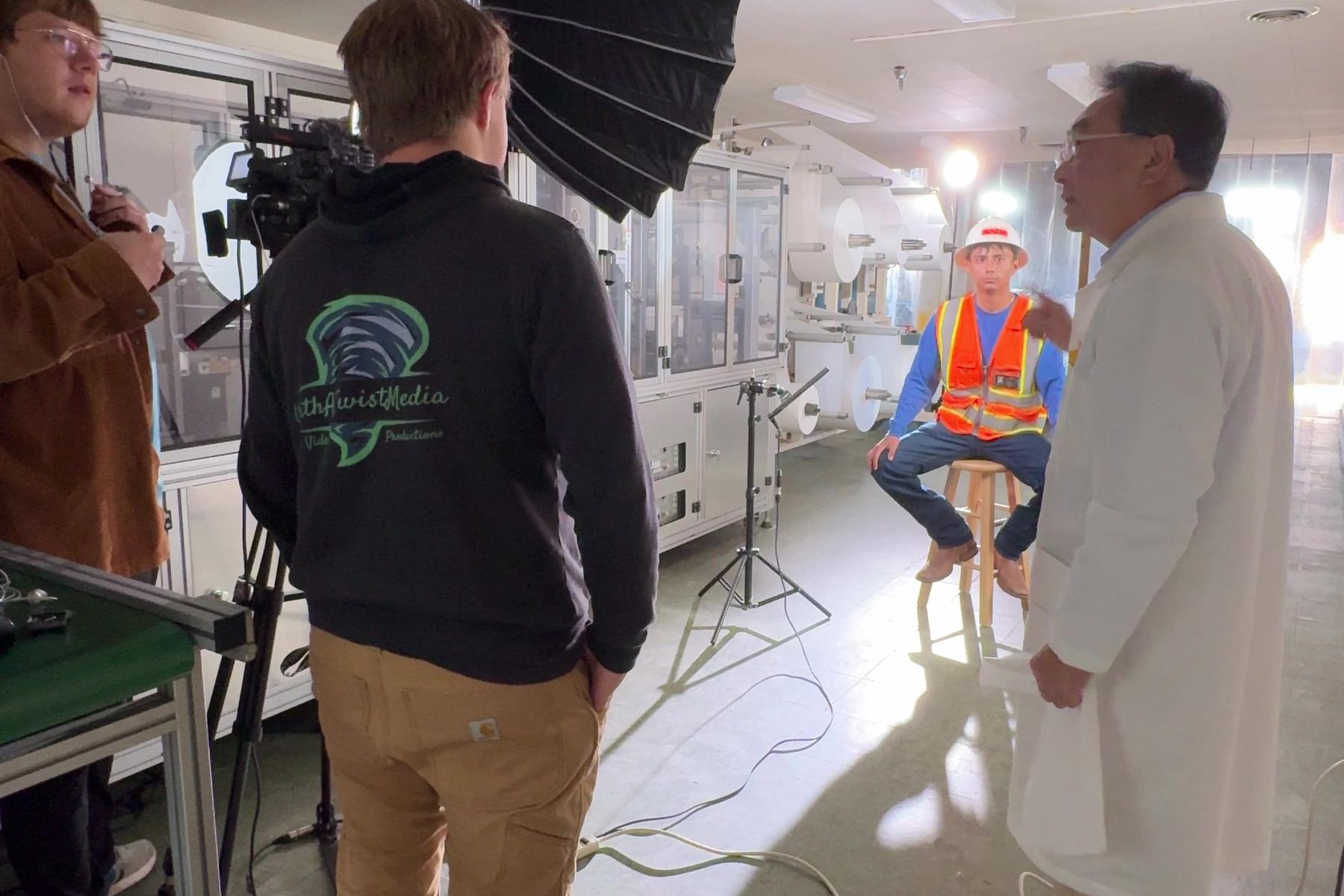
EcoFiber, a manufacturer in Colfax, needed a 50,000 square foot former machine shop primed and painted while it was still full of equipment, moved section by section over twelve days. JD Paint Pros did the work. We filmed day three and day ten, and the finished piece runs under two minutes. Carlos, the painting company's owner, sends it to nearly everyone who asks about a building.
Working inside a building full of someone else's equipment is what a plant owner worries about first. That film answers it for painting. Yours has to answer it for a classified room.
On regulated sites, gowning and site rules apply to us the same as everyone else, and they get sorted before shoot day.
Where video does not help
It will not replace your safety record, your references, your qualification documentation or a clean turnover package. If those are weak, video will not save the shortlist.
What it does is make the rest believable. More on general contractor video.
The short version
- Owners chasing pharma, biologics and battery work want proof of controlled space work, not a lab on a slide.
- Name the room, the class and the systems. FDA guidance puts ISO 5 at 3,520 particles of 0.5 microns or larger per cubic meter.
- Put the superintendent and the owner on camera, and film the protocol while the work is happening.
- Check your contracts before you use any photo from an owner's site.
- Video makes your record believable. It does not replace the record.