
A customer walking your floor is about as close as they will ever get to seeing what they are buying.
Most tours waste it. They start in the lobby, go room by room in whatever order the building is laid out, and end at the front door with a handshake. Everybody is polite. Nobody remembers much.
We film inside plants for a living, so we spend a lot of time noticing what a stranger sees on a floor and what they walk right past. Almost all of what follows works with or without a camera.
Follow their order, not your floor plan
Visitors do not care how your building is laid out. They care how their order moves through it.
So walk it that way. Where the material comes in. Where it gets checked. The station where it becomes their part. The inspection that stands between them and a bad shipment. The dock it leaves from.
Every stop should answer a question the buyer already has. Can you handle my volume? Who touches my order? What happens when something goes wrong?
Skip the stops that answer nothing. The empty training room and the trophy case can wait for another visit.
Talk before the loud part
The worst place to explain anything is next to the press.
NIOSH, the federal agency that researches workplace safety and health, says that at 85 decibels you often have to raise your voice to be heard by someone three feet away. At 95 decibels or more, you are likely shouting. If your floor runs anywhere near that, nobody on the tour will ask you to repeat yourself. They will just nod.
So pick your quiet spots before the visit. Explain what they are about to see, walk them through it, and regroup on the other side to ask what it raised. Where hearing protection is required, visitors wear it too. Move the conversation, not the rules.
Let the people at the station do the talking
A plant manager leading the tour is normal. A plant manager doing all the talking is a missed chance.
The operator. Ask her to explain what she watches for. That says more about your quality than a slow walk past a machine.
The inspector. Have them hold up a part they rejected and say why it would have mattered to the customer.
The longest serving person on the line. Consistency is a big part of what a buyer is paying for, and twenty years at one station is proof of it.
Give each of them a heads up the day before and one question to answer. Not a script. A question.
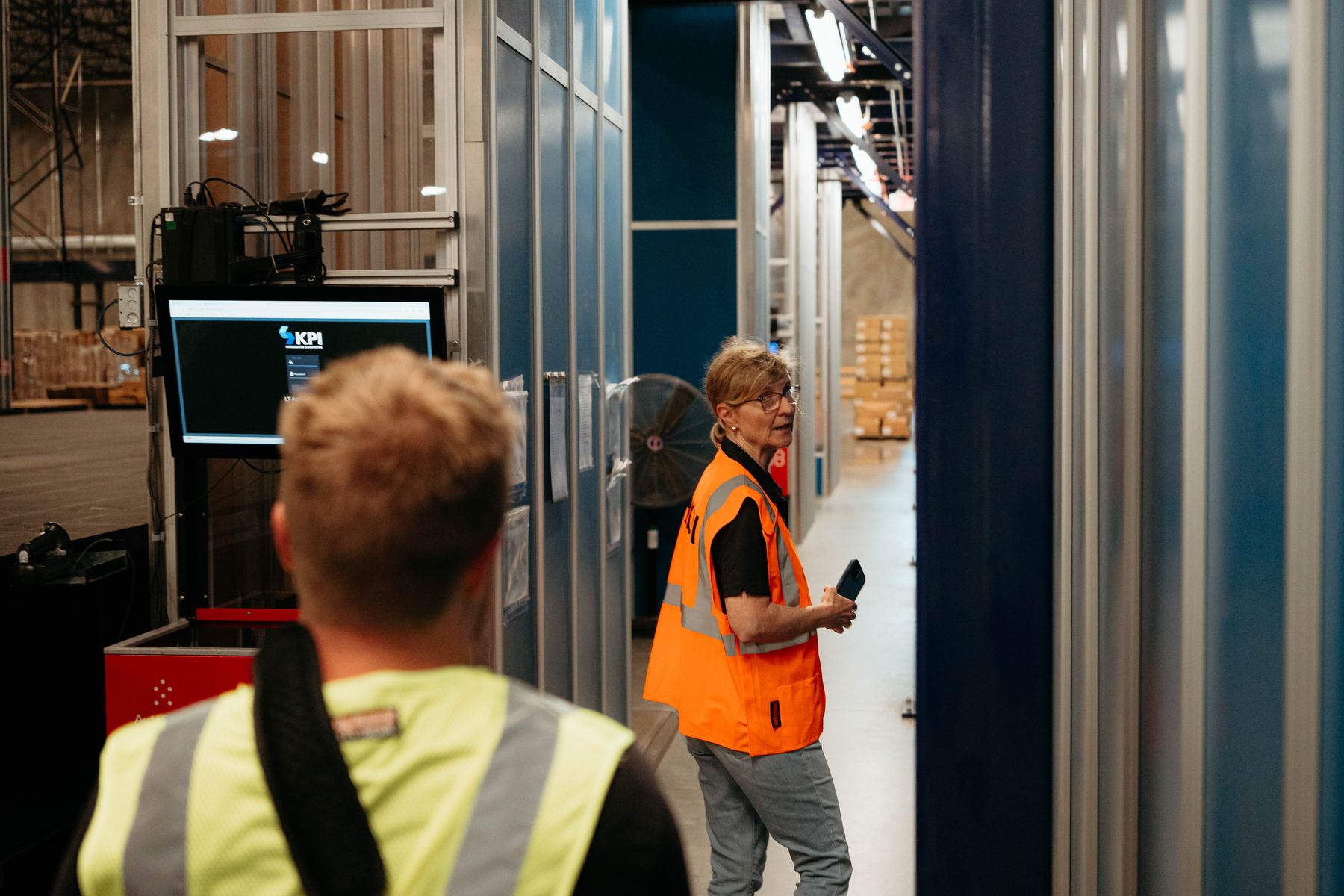
Then there is the thing nobody can see from the aisle. We spent one day on location at LT Apparel's distribution center in Dayton, New Jersey, filming for KPI Solutions, the integrator that spent years redesigning the operation. Walk that floor and you see robots. You do not see that the operation once needed over 600 associates fulfilling orders and now runs with fewer than 200.
Nobody learns that by looking. Somebody has to say it, at the spot where it happened. Every plant has a number like that. Find yours and put it on the route.
End on purpose
In a 1993 study in Psychological Science, Daniel Kahneman and colleagues had 32 students hold a hand in water at 14 degrees Celsius for 60 seconds. In another trial they held it for the same 60 seconds, then 30 more while the water warmed slightly. Asked which one to repeat, 22 of the 32 chose the longer trial.
More discomfort, better memory, because it ended better. People judge an experience heavily by how it ends.
Most tours end with a walk back to the lobby. End at your strongest stop instead. The finished product, the test it has to pass, or the person who ships it. Then sit down and ask what they would want to see next time.
For the people who never make the trip
Here is the honest part. The person on your tour is rarely the only one deciding. Their boss, their quality team and their finance person are back at the office, hearing a secondhand version.
That is where video helps. Not as a replacement for the visit, because nothing beats standing on the floor. As the version of the visit that travels.
If you film it, shoot it the way you walk it. Same route, same people, same number said at the same spot. We walk a plant floor before shoot day whenever we can, because walking it first changes what we film. More on what goes into a plant tour video.
The line keeps running while we work. If that is the worry, here is whether filming will disrupt production at your plant.
The short version
- Walk the route your customer's order takes, not your floor plan.
- Explain before the loud areas. At 85 decibels, people raise their voices to be heard three feet away.
- Let operators and inspectors talk, and say your best number at the spot where it happened.
- End at your strongest stop, because people judge an experience by how it ends.
- Film the same route for the people back at the office who never make the trip.