
Every plant has a job that looks fine in the posting and empties out by week three.
The posting said competitive pay, great team, room to grow. Nobody mentioned the twelve hour shifts, the heat by the ovens, or that the first month is mostly watching someone else.
So the new hire found out on day one, and left. In May 2026 alone, about 180,000 people quit manufacturing jobs, according to the Bureau of Labor Statistics.
There is a name for the fix. A realistic job preview. You show people the real job, hard parts included, before they commit.
What the research actually says
This has been studied for decades, and the findings hold up.
A 1998 review of 40 studies by Jean Phillips in the Academy of Management Journal linked realistic job previews to fewer people dropping out of hiring, lower voluntary turnover, and higher performance.
A larger review in 2011, by Earnest, Allen and Landis in Personnel Psychology, covered 52 studies and about 17,000 people. It found the main reason previews work is honesty. When a company shows the hard parts, new hires believe the rest of what it told them.
The effect is real but modest. A preview will not save a bad job. It points at something every plant manager already knows, though.
People rarely quit because the job is hard. They quit because it was not the job they were told about.
Where video helps, and where it does not
We make video, so here is the honest version.
That 2011 review suggested the strongest previews are spoken or written, and that previews given after the offer, during orientation, work a little better than ones given before.
So the answer is not a video instead of a conversation. It is both, at different moments.
Before someone applies, video does what a job posting cannot. It shows the floor, the noise, the gear, the pace, and the person who will train them. The wrong people opt out on their own, and the right ones show up already knowing what they are walking into.
On day one, a supervisor walks them through the hard parts again, in person. Video does the filtering. People do the rest.
What to film
We spent a day inside Apex Dental Laboratory Group, a lab that makes dentures and mouth guards. Almost nothing about that work comes across in a job posting.
What we filmed was the job. Technicians at their benches. A technician at his CAD screen. A 3D printer laying down a mouth guard behind an amber window. The lab kept working the whole time, and each interview took about twenty minutes. That is the raw material a preview is made of.
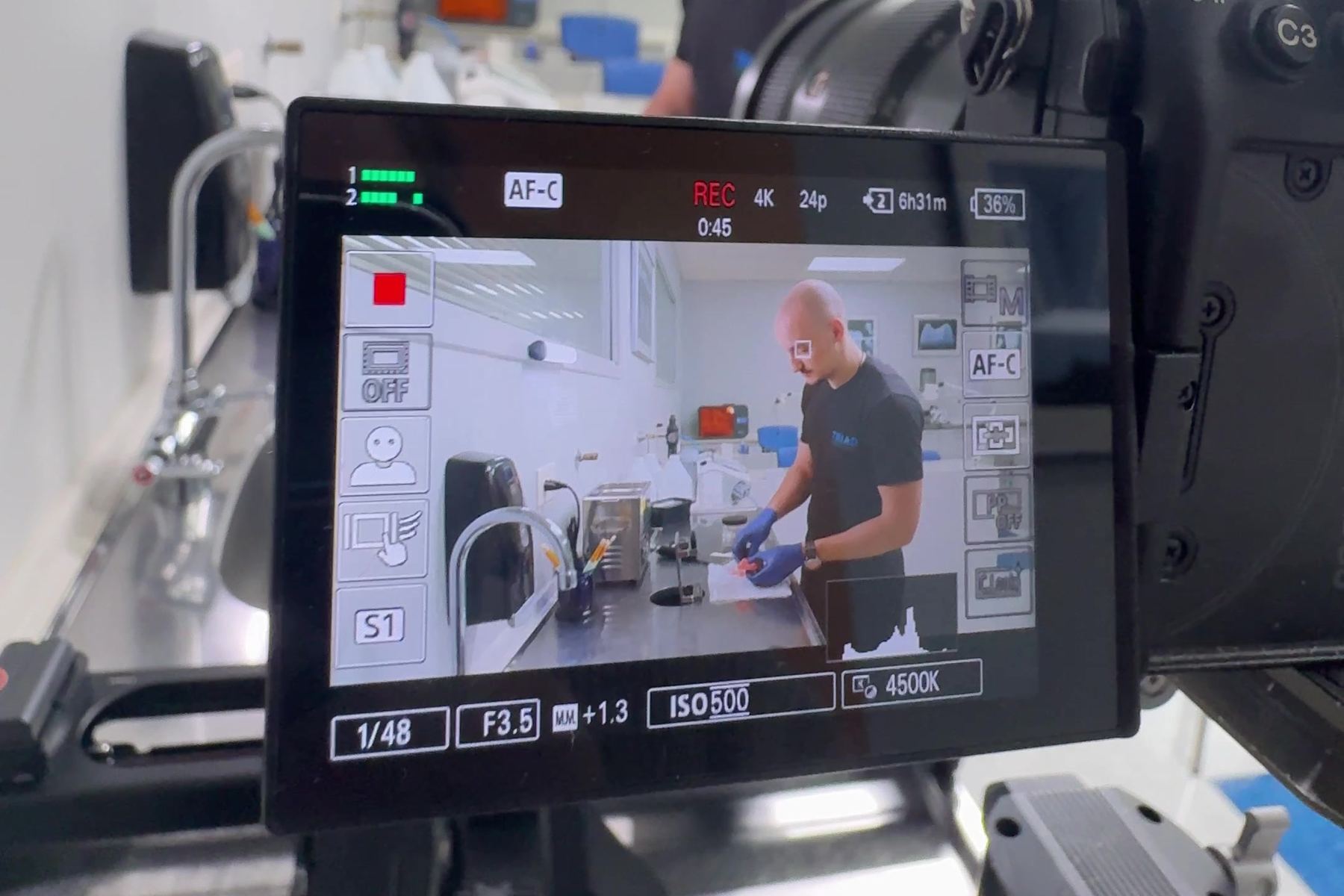
Here is what to get on camera at any plant or lab.
The actual workstation. Where they will stand or sit for a full shift. The real one, not the cleanest corner of the building.
The hard part, said out loud. The heat, the noise, the precision, the overtime. Have someone who does the job say it, and say why they stay anyway.
The first month. Who trains them, and how long until they run something on their own.
The schedule as it really is. Shifts, weekends, overtime.
The person who started last year. A new hire needs to see someone like them who made it past the first ninety days.
None of this needs a script. It needs someone willing to answer honestly. More on what a manufacturing recruitment video should show.
Where to put it
- At the top of the job posting, above the apply button. That is where people decide whether to apply.
- In the text you send when someone books an interview.
- On the careers page, where spouses and parents look too.
- One clip per role. A machining job and a maintenance job are different jobs, and they deserve different previews.
The short version
- A realistic job preview shows the hard parts before people commit.
- Two big reviews, one of 40 studies and one of 52, tie previews to lower turnover. Honesty is why they work.
- Use video before someone applies, so the wrong people opt out. Walk them through it again in person on day one.
- Film the real workstation, the hard part said out loud, the first month, the real schedule, and someone who started last year.
- Put it above the apply button.