
Somebody at your plant has been asked to put the work instructions on video. Somebody else wants to know if that means the SOPs go away.
They do not. The written procedure and the video do different jobs, and a plant that treats them as rivals ends up with two versions of the truth.
Where the written SOP wins
It is the controlled document. If you make finished drugs, FDA's rule at 21 CFR 211.100 requires written procedures for production and process control. They have to be followed, and any deviation has to be recorded and justified. An auditor asks for a procedure with a revision number and an approval. A video does not replace that.
It holds the exact numbers. Torque values, temperatures, part numbers, tolerances. People look those up in the middle of a task, and scanning a table is faster than scrubbing through a video.
It changes cheaply. A new spec is an edit and a signature. On video, the same change can mean a reshoot.
It works without a screen. A laminated page at the station does not need a charger, a login or a signal.
Where video wins
Video wins on motion.
Tim Höffler and Detlev Leutner pulled together 26 studies and 76 comparisons of animated and video instruction against static pictures, published in Learning and Instruction in 2007. Moving instruction had a medium sized advantage overall. For procedural motor knowledge, the kind you use to do something with your hands, the advantage was close to three times as large.
The same analysis found that decorative animation, motion added to look nice, did no better than a still picture. That is the honest limit. A video of a supervisor reading the SOP out loud is decoration. The gain comes from showing hands, order and position, the things words describe badly.
Reading is the other reason. In the 2023 adult skills survey reported by the National Center for Education Statistics, 28 percent of working age U.S. adults scored at or below Level 1 in literacy, up from 19 percent in 2017. That says nothing about any one person on your floor. It does say a dense four page procedure asks a lot of a lot of people.
So the split is simple. Video is how someone learns a task the first time. The SOP is what they check the hundredth time.
How to tie them together
Most of the trouble comes from the two drifting apart. A few rules keep them honest.
The SOP is the source of truth. The video shows how to do what the SOP says. It never says something different.
Stamp the video with the SOP. Put the procedure number and revision on the first frame and in the file name. Put a QR code to the video on the procedure.
Leave the numbers on paper. Show the motion on camera and point to the SOP for the value. Then a spec change means a document edit, not a reshoot.
Check the video when the revision changes. Same day, same owner. If it no longer matches, pull it until it does. In regulated work, a video that contradicts the procedure is a deviation waiting to happen.
Watch for the real way. Filming a task exactly as written can show that the floor does it differently. Fix the procedure or the practice before you roll, not after.
Filming in a controlled space
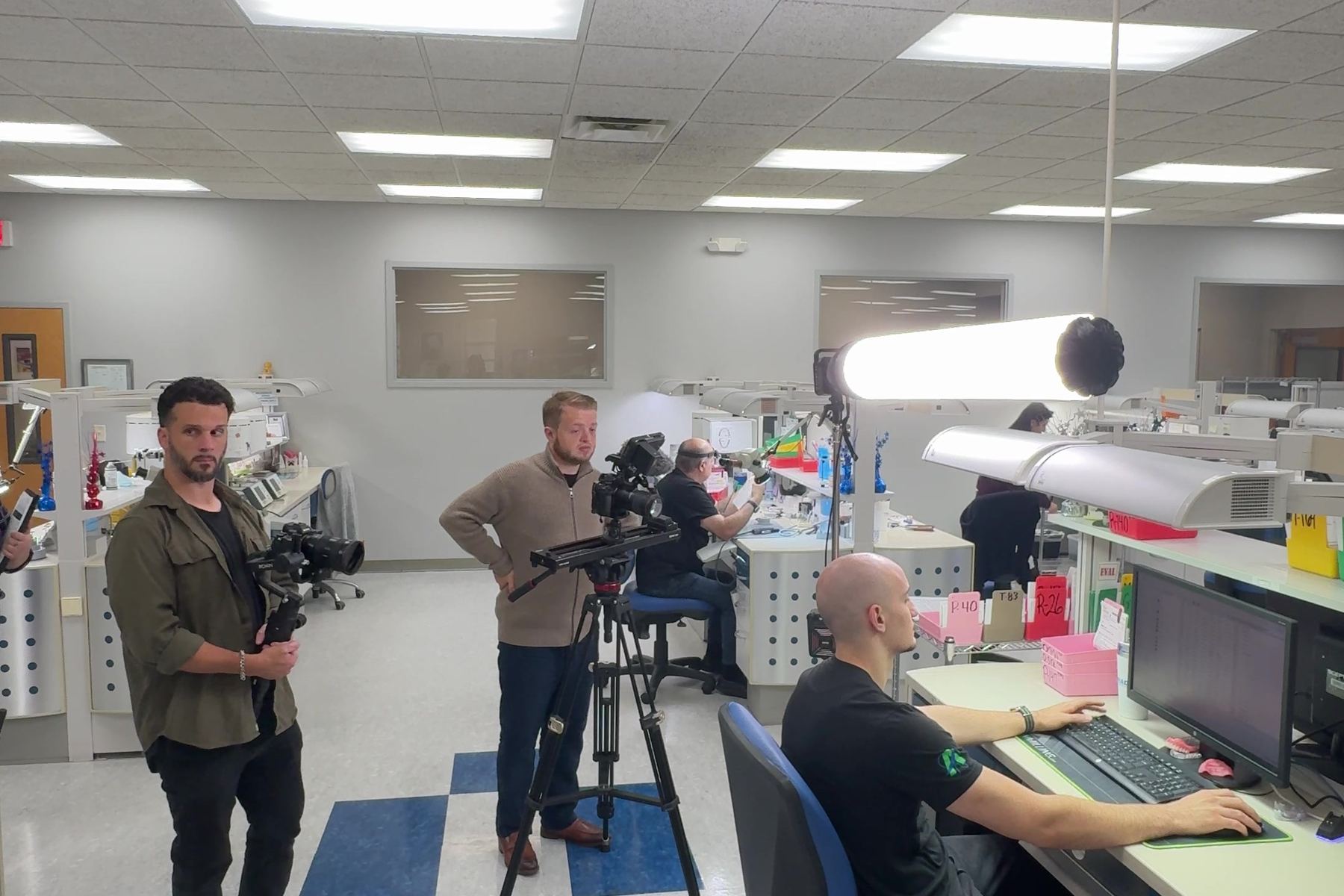
We spent a day filming inside Apex Dental Laboratory Group, a lab that makes dentures and mouth guards, with two cameras and no script, while the lab kept working.
Regulated spaces have rules, and they apply to the crew the same as everyone else. Gowning and lab rules get sorted before shoot day. No patient information goes on camera, screens get checked before we roll, and nothing is published without your approval. More on medical and dental lab video.
For a work instruction, the SOP is the script. The operator runs the steps in order, the camera stays close on the hands, and the finished video goes through the same review as the document it matches.
One more distinction. A procedure holds the steps. The judgment your most experienced people use between the steps is a different job for video, and a different post: capturing what only one person knows.
The short version
- The written SOP is the controlled document. Keep it, and keep it current.
- Video wins on motion. Research shows large gains for hands on tasks and none for decoration.
- Keep exact values on paper so a spec change does not force a reshoot.
- Stamp every video with its SOP number and revision, and check it whenever the SOP changes.